Here’s my bias up front: if you build a Gold Coast patio like it’s in a mild, dry climate, you’re basically pre-ordering rust, warped boards, and that permanent “salt haze” look.
The Gold Coast is generous with sunshine and brutal with exposure. Heat bakes finishes. Humidity inflates timber. Summer storms test every joint. And if you’re anywhere near the water, salt gets into places you didn’t even know existed. The trick is designing for all of that from day one, materials, airflow, shading, drainage, and the annoying little details like fasteners and fabric zips.
One-line truth: comfort is engineered.
Start With the Real Brief (Not the Pinterest Brief)
Before you pick a tile or a pergola profile, lock down three things: what you do out there, what your site does to you, and what you refuse to maintain.
I’ll often ask clients to map the patio across a normal year, not a perfect Saturday. Where does the late-afternoon western sun punch in? Which direction does the storm wind come from? Where does water actually run when it dumps? If you’re researching Gold Coast patios, these site-specific details matter more than inspiration photos.
If you’re not sure where to begin, aim your criteria at these:
– Thermal comfort: shade + breeze paths + heat-soak control
– Salt and corrosion resistance: especially fixings, lights, and furniture frames
– Drainage and dry-out speed: after a downpour, how fast can it be usable again?
– Maintenance ceiling: monthly rinse? annual oil? never-touch-it-again?
– Upgrade potential: can you add blinds, fans, or heaters later without ripping everything apart?
Now, this won’t apply to everyone, but if your budget is tight, spend disproportionately on the “boring” stuff: slope, waterproofing layers, structural frame, and hardware. Pretty surfaces are easy to change later. Rotten subframes aren’t.
Materials: What Lasts When Salt, Sun, and Humidity Team Up
Look, coastal conditions don’t negotiate.
Metals (the part people get wrong)
Bare steel is a heartbreak. Even “galvanised” can struggle long-term in salty air if detailing is sloppy. I’ve seen gorgeous patios where the structure lasted, but every screw head bloomed orange within a year because someone saved a few dollars on fixings.
Choose:
– Powder-coated aluminium for frames, screens, and furniture (lightweight, corrosion resistant)
– 316 stainless steel for exposed fasteners and key hardware in coastal zones
– Hot-dip galvanised for certain structural components if properly detailed and isolated from dissimilar metals
Avoid mixing metals casually. Galvanic corrosion is real, and it loves a damp coastal environment.
Timber, composite, and the honest truth about “low maintenance”
Timber can work beautifully on the Gold Coast, but only when it’s allowed to breathe and you accept upkeep as part of the deal.
– Spotted gum / blackbutt can perform well when detailed correctly (ventilation, sealing schedule, correct gaps).
– Ipe is durable, but it’s dense and not everyone wants the sourcing questions that come with it.
– Composite decking is often the lowest-fuss option visually and practically, especially if you pick a quality board that won’t feel plasticky underfoot.
If you hate maintenance, don’t build a timber-heavy patio and pretend you’ll “keep up with oiling.” You won’t. (Most people don’t.)
Pavers, tiles, and stone
Dense, low-porosity surfaces win in humidity. Porcelain pavers are a quiet overachiever: stable, stain resistant, and consistent in colour. Concrete pavers can be excellent too, but sealing and slip rating matter.
A quick technical note: outdoor flooring should be chosen with wet traction in mind, not showroom lighting. Aim for appropriate slip ratings for external use (your supplier should confirm, not guess).
Shade Isn’t Optional. It’s the Project.
A patio without serious shade on the Gold Coast isn’t “bright and airy.” It’s unused by 11am.
Shade is also not one-size-fits-all. You’re balancing UV, rain shedding, wind tolerance, and airflow. And yes, the best solution is often layered.
Shade styles that actually make sense here
Sometimes a simple list is the clearest way to call it:
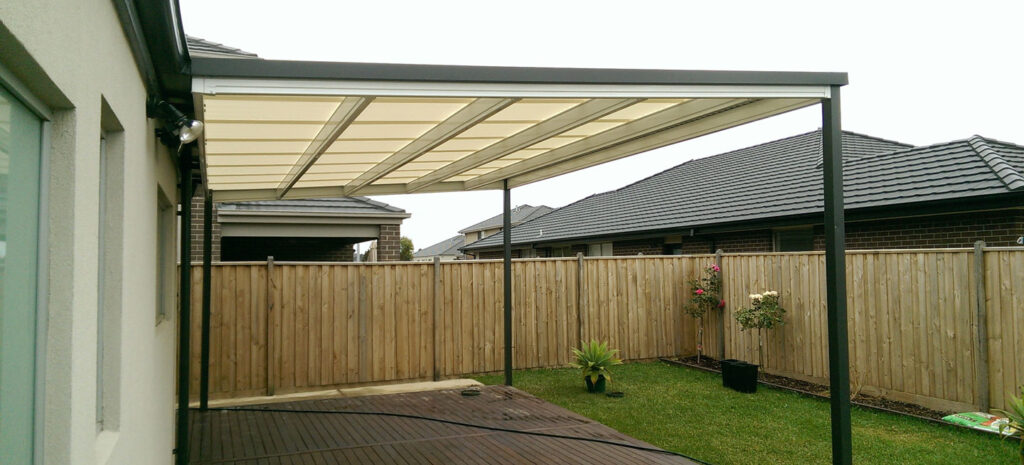
– Insulated roof panels (for real rain protection and heat reduction)
– Pergola + adjustable louvres (excellent control, more moving parts)
– Shade sails (cost-effective, but design carefully for wind loads and tensioning)
– External blinds/screens (glare and privacy control, also helps with sideways rain)
I’m opinionated on this: if your patio is meant to be used through summer storms, sails alone usually disappoint. They’re shade first, weather second.
A stat worth knowing
UV is not theoretical up here. Australia regularly experiences “Extreme” UV Index days, and the Bureau of Meteorology notes that UV levels are commonly high enough to cause skin damage year-round in many parts of the country. Source: Australian Bureau of Meteorology (UV and Sun Protection guidance), https://www.bom.gov.au/uv/
So yes, design for shade like you mean it.
Drainage and Moisture: The Stuff That Separates “Nice” From “Still Nice in Five Years”
If water sits, things rot, stain, swell, or grow fur. Pick your poison.
A proper drainage plan isn’t just “add a drain.” It’s a system:
– Grade the surface so water moves away from the house and away from foot traffic zones
– Use gutters and downpipes sized for heavy rainfall events (and keep them accessible for cleaning)
– Control discharge into legal stormwater points or approved soakage solutions
– Detail thresholds so runoff can’t sneak under doors during a sideways storm
– Ventilate substructures under decks to prevent trapped humidity
Here’s the thing: drainage should look boring when it’s done right. Flush grates. Hidden channels. Gravel strips that read as “design” but function as runoff paths.
And don’t ignore the “dry-out” factor. Surfaces that breathe and assemblies with airflow recover faster after rain, which means less mildew and fewer slippery patches.
Airflow and Ventilation (Because Shade Alone Can Feel Like a Sauna)
You can shade a patio and still make it unbearable if you block every breeze. Subtropical comfort is a game of moving air across skin, not sealing yourself into a cave.
I like to think in wind lanes. Where does air enter? Where does it exit? What’s obstructing it?
Tools that work:
– Ceiling fans rated for outdoor use, positioned to wash air across seating (not just spin above empty space)
– Louvre panels and adjustable screens to “steer” breezes
– High ceilings in covered areas so heat can stratify above people
– Planting as porous screening rather than solid walls everywhere
One small warning: glass balustrades look clean, but they can also create a greenhouse edge if you combine them with a low roof and poor crossflow. Sometimes you need a vented top section or a different wind strategy.
Finishes That Don’t Turn Into a Weekend Job
Some finishes age with grace. Others just… degrade.
For coastal patios, I lean toward:
– Porcelain pavers or sealed concrete for easy wash-down and consistent colour
– Textured exterior coatings that handle salt haze and scrub clean
– Powder-coated aluminium screens rather than painted steel
– Outdoor-rated fabrics (solution-dyed acrylics are a reliable staple)
Cool neutrals tend to hold up visually in harsh light, and they don’t show salt residue as aggressively as deep charcoals or glossy blacks (which look amazing for about five minutes after cleaning).
Layout & Zoning: Build It Like a House, Not a Leftover Slab
A good patio isn’t a single “outdoor area.” It’s a set of micro-zones that give you options when the weather shifts.
You’ll usually want at least three:
– Dry core zone (covered): dining table, outdoor kitchen, main seating
– Breezy edge zone (semi-covered): lounging, reading chair, hammock, daybed
– Open sun zone (uncovered): winter warmth, herbs, plunge pool edge, sun lounge
Make circulation obvious. Avoid pinch points. Keep wet pathways from cutting through the dining area (you’d be surprised how often that happens).
And please, give yourself a storage plan. Cushion boxes, a bench with integrated storage, even a discreet cabinet. If textiles can’t be stowed quickly, they’ll end up damp, and then they’ll smell.
Furniture and Accessories: Buy for Salt, Not for Showrooms
If it’s going to live outside, it needs to tolerate:
– UV
– salt
– sudden rain
– long humid stretches
My practical favourites: powder-coated aluminium, high-quality resin wicker, marine-grade teak (if you accept its weathering), and recycled plastic for truly low-fuss pieces.
Cushions should be quick-dry foam where possible, with solution-dyed covers and proper zips. Cheap fabric is the fastest way to make a nice patio feel tired.
Lighting? Go corrosion-resistant and low-glare. Warm LEDs, shielded where needed, and placed to guide movement without blasting everyone in the eyes.
A Maintenance Rhythm That Won’t Ruin Your Life
Two or three sentences, because that’s all it needs: rinse salt off surfaces periodically, clear gutters before storm season, and inspect fixings after big wind. Small, frequent checks beat heroic annual “patio weekends.” Every time.
If you want a simple seasonal pulse:
– Pre-summer: gutters, drainage paths, fan check, shade tension/hardware
– Mid-summer: wash-down, mildew watch, touch-up seals where needed
– Autumn: corrosion inspection on furniture and fittings, store or rotate textiles
– Winter: storm-damage check, re-seat pavers/boards if movement appeared
You don’t need to overbuild a bunker. You just need to respect the climate, then design like you plan to actually live there.
